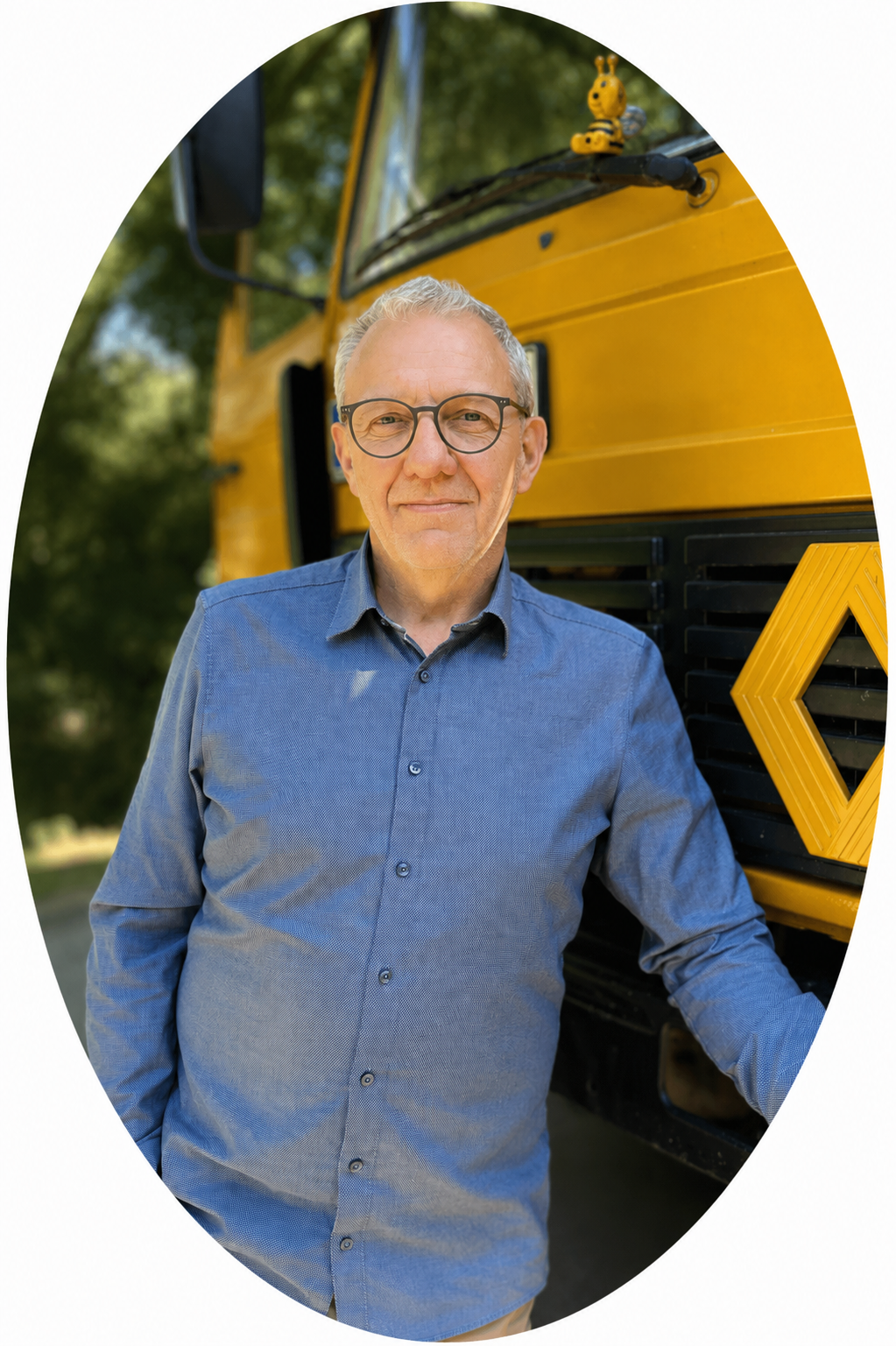
For me, being different means questioning systems and opening new paths.
Entrepreneur. Crisis manager. Coach.
I know responsibility from more than an observer’s perspective.
My perspective comes from companies, major projects and crises –
and from a personal turning point that forced me to understand
responsibility in a different way.
I know what it feels like to make decisions whose consequences
do not remain abstract. They affect companies, projects, jobs and
people. That experience continues to shape how I listen, ask questions
and accompany change.
Between workshop floor, boardroom and wilderness
I have learnt to translate between different worlds.
My professional path began in the practical reality of technical
and skilled work. There, what matters is not how convincing an idea
sounds, but whether it works under real conditions.
Later, I founded and led a limited company with more than 200 employees,
co-founded a construction company structured as a public limited company
and served on its supervisory board. In national and international
projects, I worked with start-ups, medium-sized companies and
international corporations.
I therefore know not only companies of different sizes, but also the
different realities within an organisation: operational work, economic
constraints, strategic decisions and the dynamics between people,
roles and structures.
At the same time, I repeatedly sought situations in which familiar
certainties were no longer available: travelling through the desert
in an expedition truck, cycling alone in the Himalayas or sleeping
beneath the stars on remote mountain passes.
These experiences expanded my perception. In autonomy and silence,
it quickly becomes apparent what truly sustains us, which decisions
are necessary and where we are deceiving ourselves.
Today, I bring these worlds of experience together. I speak the language
of the workshop floor as readily as that of senior management, understand
the culture of each and take operational constraints as seriously as what
happens between people, roles and structures.
The turning point
Responsibility must not end in attrition.
For a long time, I believed I could control the strain. Then my body
pulled the emergency brake.
The collapse was not a single event, but the accumulation of many years.
It forced me to face a question that could no longer be answered through
performance:
Do I want to continue like this – or am I prepared to carry responsibility differently?
The way back consisted of two years of decision and three years of
transition. Five years in which I experienced how much courage, patience
and honest confrontation it takes to change one’s life fundamentally.
I know the mode in which people function, solve problems and take on ever
more responsibility. This “warrior mode” can take companies a long way.
At the same time, it can consume founders, leaders and teams from within.
This experience makes me cautious about quick promises. Change is possible.
But it needs a sustainable setting, an honest assessment of the situation
and respect for the people expected to implement it.
Experience meets craft
My experience was complemented by methodical training.
My path did not begin in a coaching room. I worked on technical systems,
led companies and took responsibility in projects where decisions had
tangible economic and human consequences.
Today, this helps me avoid beginning at the surface in organisations.
I can consider practical implementation, economic reality and human
dynamics at the same time.
Structured project management, an MBA from the University of Wales Cardiff
and training as a mindfulness-based systemic coach – MbsC according to
DGSF standards – were added later.
For me, systemic work therefore does not mean disregarding economic or
operational reality. It means understanding more precisely how decisions,
structures, relationships and different perceptions interact.
For you, this means that I can take economic requirements seriously,
consider practical consequences and, at the same time, make visible the
dynamics that support or prevent change.
Today
Between Germany, France and new perspectives.
Today, my partner Anja and I live and work between Germany and France.
On our five-hectare nature property in the Var, spaces for retreat and work
are taking shape for people who consciously want to take time and distance
from their familiar environment. Places where they can look at their
situation afresh, develop new perspectives and gain clarity about what
matters next.
Some conversations have their effect within the company. Others gain depth
in a neutral place. And sometimes an entirely different setting – in nature
or while travelling in our expedition vehicles – opens up new perceptions
and possibilities for sound decisions.
Which setting is appropriate depends on the particular concern and on what
best supports clarity, development and good decisions.
How would you like to continue?
Perhaps you would like to begin with a personal conversation, learn more
about the stance behind my work or explore my path in greater detail.
Begin with a confidential conversation
You may be facing a situation for which there is no simple or
ready-made answer.
In an initial conversation, we examine together what the issue
actually is and whether working together could make sense both
professionally and personally.
“Between workshop floor, boardroom and wilderness” shows how technical
practice, entrepreneurial responsibility and personal experience shape
my work today.